
Infection Prevention and Control Training
Infection control training is incredibly important for keeping your staff, clients, and customers safe. No matter where you work or which industry you work in, the risk of spreading infections like COVID-19, influenza, and more are ever-present. Our online infection control course informs your workers on how to minimize and prevent infections in a concise and engaging format.


300,000 healthcare-associated infections cost the NHS in excess of £1 billion annually…
- Health & Safety
- 40 languages
- 35m
Learning outcomes
-
Illustrate how to break the chain of infection.
-
Identify what infections are, where they come from, and how to prevent them.
-
Review personal hygiene and the correct hygiene practices to reduce infection
Your trial awaits!
Covered in this course
Course contents
This training course is broken down into 3 sections
-
1Infections
-
2The Chain of Infection
-
3Hygiene

Section 1
We’ll begin by taking a closer look at what infections are, who’s at risk of infection, and where infections come from. Infections and infectious diseases are caused by harmful germs known as pathogens or pathogenic micro-organisms. In this section, we will look at who is at risk, bacteria, viruses, parasites and more!

Section 2
Infections are transmitted from one place to another, or one person to another, through a process called the chain of infection. We’ll look at how transmission happens and what you can do to break the chain of infection where you work. The infection control tactics you learn in this training will help you to stay healthy and avoid infections.

Section 3
Having good personal hygiene, using PPE appropriately, storing food correctly, disposing of waste safely, and keeping your environment clean are simple ways to HELP break the chain of infection around you. This is what we’ll be covering in this section.
About this course
The risk of infection is everywhere, from door handles and desks to kitchens and keyboards. And once an infection contaminates, it can be spread around a workplace in as little as two to four hours.
It’s the job of staff and managers everywhere to be aware of the risks of infections like COVID-19, Norovirus, and more. This added awareness will help staff members do what they can to help prevent diseases from spreading in the workplace. That’s where our infection control course comes in. It looks at what kinds of infections are most prevalent, what they are, how they spread, and who’s at risk. Most importantly, it considers what you can do to prevent the spread of infections at all.
Exposure to infection is largely incidental, and so is not specific to any particular working practice. However, due to the increased severity in the event that infection does take hold, this Infection Control course is particularly useful to those working in the Care Industry.
iHasco have also produced a free Coronavirus Awareness eLearning video.
Useful resources – Workplace Posters:

Presented by
Other people also bought
The importance of Infection Prevention and Control Training
It's important that you comply with the law and understand the positive impact this training course can have on your organisation and employees.
Find out moreAvailable in 40 languages
All inclusive
Machine translated* content is included for free with all our popular courses
It covers LMS navigation, course transcripts and test questions. If you don’t see a course listed in the language you require, just let us know.
*Content which is not English may be machine translated and is for assistive purposes only. We cannot guarantee the accuracy of translations.
Our most popular languages
Infection Prevention & Control certificate
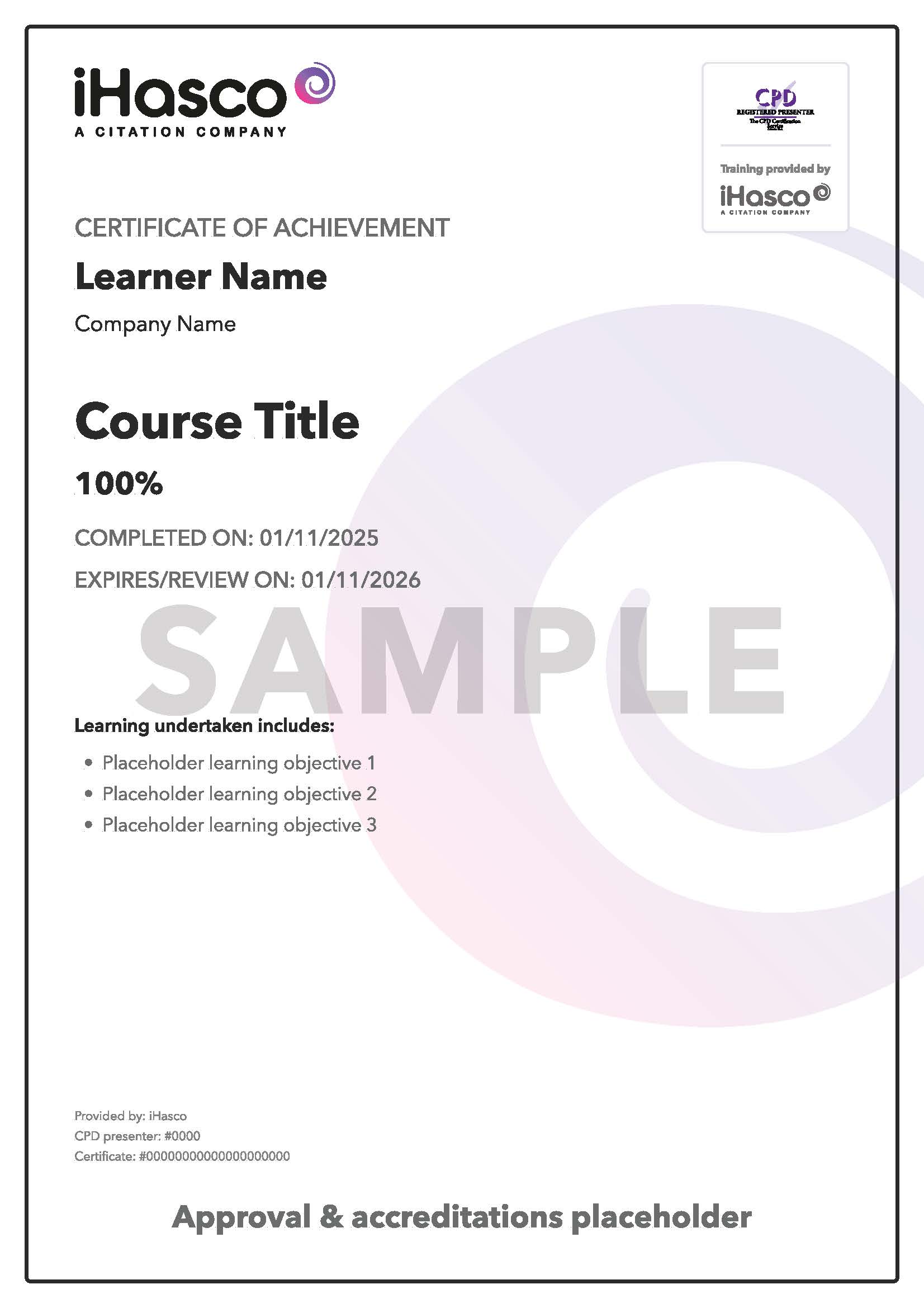
Download and print
Each of our courses ends with a multiple-choice test to measure your knowledge of the material.
This Infection Prevention and Control Training course concludes with a 20 question multiple choice test with a printable certificate. In addition, brief in-course questionnaires guide the user through the sections of the training and are designed to reinforce learning and ensure maximum user engagement throughout.
As well as printable user certificates, training progress and results are all stored centrally in your LMS (Learning Management System) and can be accessed any time to reprint certificates, check and set pass marks and act as proof of a commitment to ongoing legal compliance.
What does my certificate include?
Your Infection Prevention & Control Certificate includes your name, company name (if applicable), name of course taken, pass percentage, date of completion, expiry date and stamps of approval or accreditations by recognised authorities.
Please note if you are using our course content via SCORM in a third party LMS then we are unable to provide certificates and you will need to generate these in your host LMS yourself.
123 real user reviews
4.8
out of 5
Loading reviews…
So informative
Really interesting course which we can put the things we learn into practice at work or homec
Very knowledgeable
I have enjoyed this course
very knowledgeable i have learnt so much on this course
This user gave this course a rating of 5/5 stars
good
This user gave this course a rating of 5/5 stars
Really good and very useful information thank you
This user gave this course a rating of 5/5 stars
detailed without waffling
This user gave this course a rating of 5/5 stars
The training is simple to follow and understand
This user gave this course a rating of 5/5 stars
The training is simple to follow and understand
This user gave this course a rating of 5/5 stars
Why is this training important?
Compliance
It’s important that you comply with the law and know the ways in which it affects you and the way you work.
Infection control courses are an essential part of good Health and Safety practice across a number of work environments – from Hospitality to Healthcare, such as:
- People who work helping other people, for example, people who work in healthcare, such as care workers;
- People who work in education, particularly those who work closely with children;
- People who work in the food industry;
- Those who work in agriculture, particularly those who work with animals;
- People who work in laboratories and especially those who work with the bacterial agents that cause infections.
The following legislative documents underpin this kind of training:
Frequently asked questions
-
Infection control is important because it minimises the spread of infection and disease in both healthcare and non-healthcare settings. Infection control training teaches people how to properly disinfect surfaces, how to break the chain of infection, correct personal hygiene practices, dispose of medical waste, store food correctly, and more. Try our infection control course today!
-
RIDDOR (2013) requires that employers report injuries, diseases, and dangerous occurrences in the workplace. It’s essential to keep a record of all incidents and injuries as standard, but not all of these will need to be reported to HSE under RIDDOR. As RIDDOR covers diseases, it’s likely that you’ll need to report major infection outbreaks to the Health and Safety Executive. In addition to our online infection control course, we also provide a first aid and RIDDOR training course.
-
It’s recommended that infection control training is updated every 2 years. However, you can also complete refresher infection control courses on a more frequent basis.
-
Infection control training is not mandatory for most workplaces, but it would usually be down to an employer to arrange this type of training. The IPC (infection prevention and control) lead is typically responsible for organising and implementing infection control training in healthcare settings.
Related articles

Health & Safety, HR and Compliance FAQs
What are the risks of legionella bacteria?
Posted 11 Jun 2018

